
HomeHomeowner guidesMaintenance and replacement
Homeowner guide · Maintenance and replacement
What an air conditioning service should include
Here is what a technician should check during a home air conditioning service, how often to book one, what to ask for in writing, and what to do if something goes wrong.
The short version
- A proper service checks the refrigerant, ducts, airflow, electrics, motors and thermostat, cleans the coils, flushes the drains and clears the outdoor unit.
- Book it once a year, before the cooling season, and ask for a written summary of what was checked and anything found.
- Clean the filters and clear the outdoor unit yourself, leave the rest to a licensed technician, and put concerns about a member's work to ACDA in writing.
What the technician should check
A service is more than a filter change and a wipe-down. The ACDA e-guide lists the checks a technician should carry out, and it is a fair test of what you paid for.
- Refrigerant. The charge is checked and the system is tested for leaks with a leak detector. Any refrigerant that has to come out is captured, never released into the air.
- Ducts. On a ducted system, the ductwork is checked for leaks and sealed where it needs to be.
- Airflow. Airflow through the indoor coil is measured.
- Electrical controls and terminals. The control sequence is verified so the system cannot heat and cool at the same time, and terminals are inspected, cleaned and tightened.
- Motors and belts. Motors are checked and oiled where they can be, and belts are checked for tightness and wear on systems that have them.
- Thermostat. Checked for accuracy.
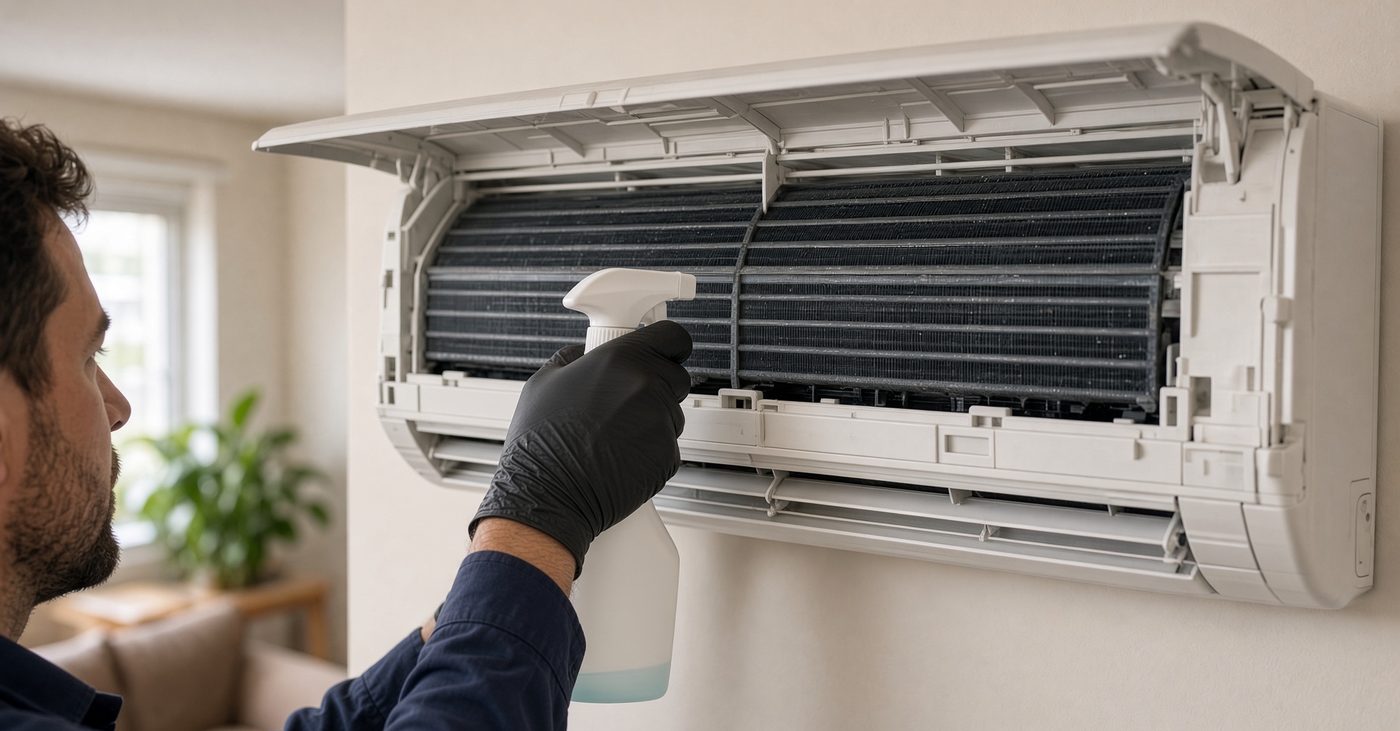
On top of that list, the indoor and outdoor coils should be cleaned, the condensate drains flushed, the filters cleaned or replaced, and the outdoor unit cleared of leaves and debris so air can move through it. If you are not sure what was done, ask.
How often to have it serviced
Once a year, before the cooling season. The ACDA e-guide recommends a professional service at the start of each cooling season, and notes that most experts suggest a yearly service to catch mould, rust and grime before they hurt efficiency.
For a home in Sydney, the Blue Mountains or Newcastle, that means booking in spring. A spring service means any repair happens before you are depending on the system.
If an accredited member installed your system, the answer is already on your paperwork. Every quote from an accredited member must state a recommended servicing frequency. For a ducted system, an annual inspection agreement with the installer is the simplest way to make sure the service actually happens.
What you should get at the end
Ask for a written summary before the technician leaves. It should say what was checked, what was cleaned, what was found and what the technician recommends. It is your record of what you paid for, and it is the document you will need if you ever have to raise a concern.
A good summary also looks ahead. It should tell you where routine maintenance is needed, where a repair is due, and when it is time to start thinking about replacement. On an older system, ask which parts need watching. That lets you plan a replacement rather than have the unit fail in the middle of summer.
If a repair is recommended, ask for it as a separate written quote. You should be able to see what it costs and decide on it, rather than find it added to the service invoice.
What you can do yourself between services
Two jobs are yours, and both make a difference to how the system runs.
Filters. Check the manual for how many filters the system has and where they are. Wash reusable filters and replace disposable ones. The ACDA e-guide recommends cleaning or replacing filters every month or two during the cooling season, and more often if the system runs constantly, the house is dusty or you have pets. A clean filter keeps the air in the house fresh, keeps the system running efficiently and takes strain off the fan motor.
The outdoor unit. Keep it clear. Remove leaves, sticks and rubbish from around it and from its intake and exhaust, trim plants back by at least half a metre so air can move through it, and keep grass clippings and dryer lint away from it.
Beyond that, watch how the system behaves. A room that no longer cools the way it used to, or a noise you have not heard before, is a reason to book a service now rather than wait for the yearly one.
What to leave to a licensed technician
Everything else. Never attempt maintenance you are unsure of, because you can do more harm than good.
Refrigerant is the clearest case. Checking the charge, finding a leak and recovering gas all need a refrigerant handling licence, which is issued by the Australian Refrigeration Council (ARC), and releasing refrigerant into the atmosphere is illegal.
Electrical work is the same. Verifying control sequences and tightening terminals means working on live parts. Ducts are less obviously dangerous, but a duct should only be repaired by a professional, so that the system works as the closed system it is meant to be.
In NSW, a trade licence is the legal minimum for air conditioning work, and it is administered by NSW Fair Trading. ACDA accreditation sits above the licence. Every accredited member must have people licensed for the work they do and must run a back-up service department, so a service from a member is done by licensed staff with a business behind them.
If something goes wrong after a service
Start with the dealer and give them the chance to fix it. Keep the service summary, the invoice and any photographs.
If the dealer is an accredited member and the problem is not resolved, put it to ACDA's Dispute Resolution Committee. Complete the Dispute Resolution Form with your details, the member's details, what was installed and when, and what the problem is. Attach your quote, your invoice and anything else relevant, such as photographs. Send it to the Dispute Resolution Committee, Air Conditioning Dealers Association Inc, PO Box 253, Emu Plains NSW 2750, or [email protected]. Every member answers to the Committee while it holds accreditation.
The ACDA Guarantee is a written workmanship guarantee on new domestic installations by an accredited member, on contracts up to $25,000 including GST, with independent Chartered Engineer review. A service on an existing system is not a new installation, so the Guarantee does not apply to it, and it is not an equipment warranty. A faulty part goes to the manufacturer under its warranty, and your member can help you lodge that claim. Australian Consumer Law rights apply as well.
ACDA is not a regulator or a licensing body, and the Committee deals only with work by its members. If a business is not on the member list, it is not a member.
Before the technician leaves
- Refrigerant charge checked and the system leak-tested.
- Indoor and outdoor coils cleaned, drains flushed, filters cleaned or replaced.
- Ducts checked for leaks on a ducted system, and airflow measured.
- Electrical terminals inspected and tightened, and the thermostat checked for accuracy.
- Outdoor unit clear of leaves and debris.
- A written summary of what was checked and anything found.
- Any recommended repair quoted separately, in writing.
- The technician holds an ARC refrigerant handling licence if they worked on the gas.
Every accredited member must run a back-up service department with licensed people, and answers to ACDA's Dispute Resolution Committee if you raise a concern. Use the dealer locator to find a member near you.
Choose an accredited dealer
Every ACDA member has already been checked against the same standard.